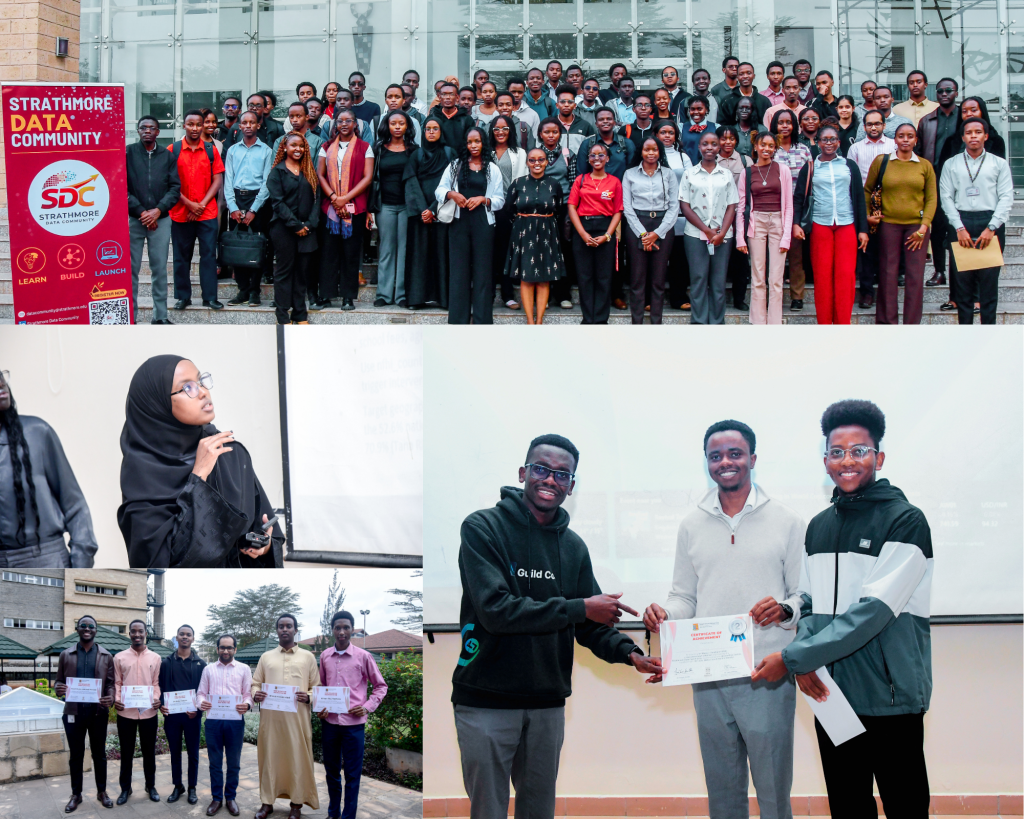
@iLabafrica-Strathmore University, through a collaboration with the Strathmore Data Community (SDC), successfully hosted the inaugural DataSprint 2026, a week-long data science hackathon that brought together 135 students to address real-world challenges in financial inclusion using national survey data.
Held from 12–19 June 2026, the competition challenged students to analyse the 2024 FinAccess Household Survey and develop data-driven solutions to understand the factors influencing the financial wellbeing of Kenyan adults.
The event attracted 45 teams comprising students from diverse academic backgrounds and varying levels of experience, ranging from first-year students to senior undergraduates. A total of 33 teams submitted completed projects after an intensive week of analysis, modelling and collaboration.
Addressing a Real National Challenge
Participants worked with data from 20,871 adults across all 47 counties, collected through the 2024 FinAccess Household Survey published by the Central Bank of Kenya, the Kenya National Bureau of Statistics (KNBS) and FSD Kenya.
The challenge required students to build machine learning models capable of predicting whether an individual’s financial situation had improved, remained the same or deteriorated, while also identifying the key drivers behind financial decline and proposing actionable recommendations for policymakers, financial institutions and development organisations.
With more than 52 percent of respondents indicating that their financial circumstances had worsened over the previous year, the competition provided students with an opportunity to engage with issues that have direct implications for millions of Kenyans.
DataSprint 2026 was designed not only as a competition but also as a practical learning experience. Prior to the challenge, participants attended a training session on the CRISP-DM framework, the globally recognised methodology for data science projects, facilitated by @iLabAfrica Research Scholar Linet Wanjira.
Throughout the week, students worked independently in teams to clean, explore, visualise and model the data before presenting their findings to a panel of industry professionals and researchers.
The competition concluded with a final showcase session, where the top five teams presented their solutions to fellow students, researchers, and data science practitioners. Participants also benefited from a professional solution walkthrough by Research Scholar Kevin Obote, offering valuable insights into industry-standard approaches to solving similar problems.
Guest speaker Natasha Nalyaka Wavomba, a Data Scientist at @iLabAfrica, encouraged students to continue pursuing opportunities within the rapidly evolving field of data science, while Mary Kiongera highlighted training programmes available through @iLabAfrica.
Celebrating Excellence
The top honours at DataSprint 2026 went to:
- First Place – Tres Amigos (Mutua Ian Mwenda, Michael Ng’ang’a Ngugi, and Emmanuel Kiptoo), who received a 100 percent @iLabAfrica course scholarship for their outstanding analytical approach, insights and presentation.
- First Runner-Up – Elite Syndicates (Charles Gacari Maina, Tijani Tatu and Tevin Omondi Warui), who earned a 50 percent course scholarship for their strong modelling methodology and interpretation of results.
- Second Runner-Up – DataPals (Poni Yokwe, Samira Yussuf and Allan Onyonka), recognised for their exceptional data exploration and visualisation work, receiving a 30 percent course scholarship.
Additional finalist teams included Team Ubuntu and Lizards, both commended for their analytical skills, teamwork and innovative approaches.
All participating teams that submitted projects received Certificates of Participation and a 10 percent discount on @iLabAfrica courses, reinforcing the organisers’ commitment to recognising learning and participation alongside competitive achievement.
A special recognition was also presented to DFT Innovators—Debra Jebet Maiywa, Fatma Alawi and Tiffany Macharia—first-year students who demonstrated remarkable courage and determination by participating in their first major data science competition during their inaugural semester at university.
A Collaborative Effort
DataSprint 2026 was made possible through the collective efforts of several institutions and teams within Strathmore University.
@iLabAfrica played a central role by providing technical leadership, challenge design, mentorship, judging and professional guidance throughout the event. The initiative also benefited from support from the School of Computing and Engineering Sciences (SCES), the Strathmore Institute of Mathematical Sciences (SIMS) and the Office of the Dean of Students.
The event involved 12 @iLabAfrica Research Scholars and Data Scientists, 18 members of the Strathmore Data Community leadership team and numerous faculty and administrative stakeholders who contributed to its success.
Following the success of its inaugural edition, the Strathmore Data Community and @iLabAfrica have announced plans for DataSprint 2027, which will feature an extended competition timeline, enhanced mentorship opportunities and additional support mechanisms to make participation even more accessible to beginners.
The organisers hope to continue providing students with opportunities to apply technical skills to real societal challenges while fostering the next generation of data professionals and innovators in Kenya.
About the Strathmore Data Community
The Strathmore Data Community (SDC) is an officially recognised student-led organisation at Strathmore University dedicated to developing future leaders in data and technology. With approximately 250 active members, the community organises workshops, industry engagements, webinars, company visits and flagship events that promote practical learning and innovation in data science.
Media Contact:
Strathmore Data Community (SDC)
Email: datacommunity@strathmore.edu