
NAIROBI, Kenya — What if a worker facing abuse could report it safely, find the right organisation to help, and track what happens to their complaint?
That question was at the heart of the Business and Human Rights Solutions Challenge, which brought together students from 13 Kenyan universities for 2 days in September 2026. The hackathon was held as part of the Cultivating Justice project, with the Centre for Education Policy and Climate Justice (CEPCJ), DanChurchAid Kenya and Pamoja Trust working together to advance responsible business practices and human rights in Kenya’s agribusiness sector.
The challenge does not end with the final pitch. @iLabAfrica – Strathmore University will provide incubation support to the winning teams, helping promising ideas move from the hackathon into the next stage of development.
Held under the theme “Code for Dignity. Innovate for Impact,” the two-day challenge gave students an opportunity to develop practical technology solutions to real human rights challenges affecting workers, farmers and communities in Kenya’s agricultural sector.
The Cultivating Justice project has spent the past year working with more than 100 agribusinesses across Nakuru, Nyandarua and the Nairobi metropolitan area, helping businesses understand and put into practice their responsibilities towards workers, farmers and communities. The hackathon extended that work by bringing young innovators into the conversation.
Before developing their solutions, participants heard from leaders and practitioners working across technology, human rights, business and development. Among them was keynote speaker Lorna Ogolla Omondi, Strategic Partnerships Lead at Google Research Africa, who challenged participants to keep learning and adapting. Reflecting on her own journey, she left them with a simple message: “Don’t quit.”
Karen Poore, Country Director, DanChurchAid Kenya, urged participants to think beyond ideas that work only in a hackathon setting. Her challenge was to “Build something that survives beyond the hackathon,” balancing meaningful accountability for human rights with practical commercial thinking.
For Florence Shako, Executive Director, Centre for Education Policy and Climate Justice (CEPCJ), the value of the experience extended beyond the solutions being built. She reminded participants: “Your network is your net worth,” encouraging them to connect with people, listen to experts and build relationships that could open doors beyond the two-day event.
Students also engaged with a panel on embedding business and human rights in university education. The panel featured Dr. Melissa Njoroge-Muindi, Lecturer at Strathmore Law School; Christina Arrumm, Business and Human Rights Lead at the Kenya National Commission on Human Rights; and Stephen Kamaara, a law graduate from Kenyatta University School of Law. Joanne Kirimi-Gikonyo, Human Rights and Responsible Business Conduct Lead at DanChurchAid Kenya, moderated the discussion.
The discussions gave participants context on the challenges they were being asked to address before they moved into ideation, mentorship and solution development.
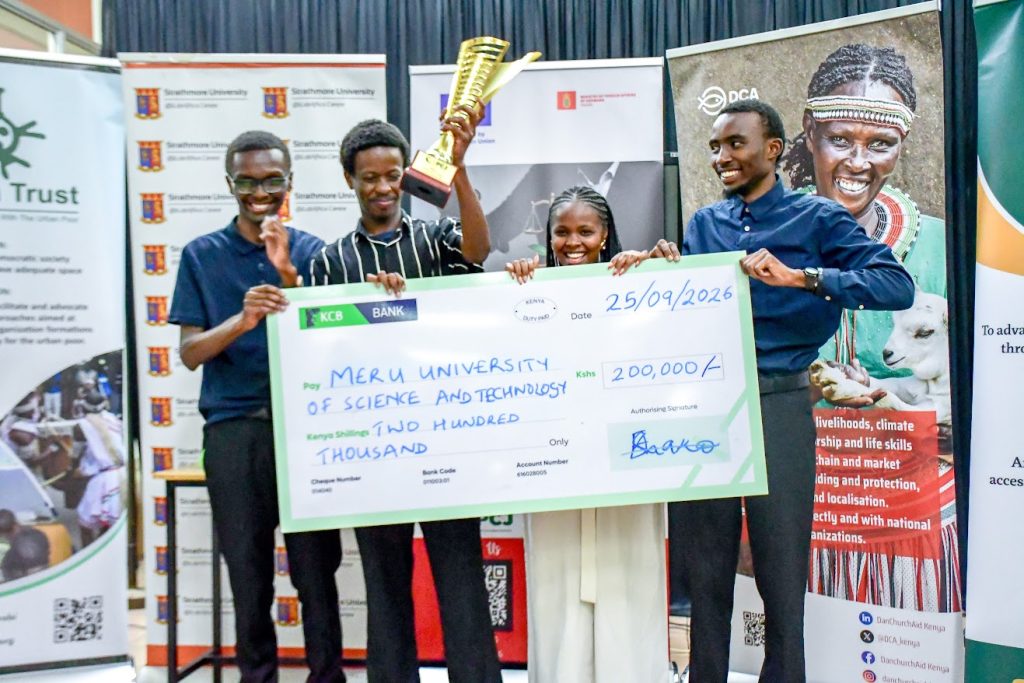
After two days of problem-solving and high-stakes pitching, Meru University of Science and Technology (MUST) emerged as the winner with a solution called HakiTrail- a reporting and case-tracking solution, allowing workers to raise complaints through WhatsApp, USSD or a web application, helping reports reach the appropriate organisation while giving workers a way to follow their cases.
Strathmore University took first runner-up with AgriHaki, a solution designed to give employees a safer way to report workplace concerns, access remedy and speak up without fear of retaliation.
Africa Nazarene University took second runner-up with K-Safe, a technology-driven solution that addresses the same challenge by making reporting more accessible – think of a farmer without a smartphone – while prioritising data protection. The farmer can easily send a simple SMS and get the help they need.
Three other teams also received special recognition: United States International University-Africa won Best Pitch & Presentation; Mount Kenya University, Parklands Campus received Most Scalable Solution; and Jomo Kenyatta University of Agriculture and Technology (JKUAT) received Outstanding Human Rights Impact.
The winning team will now have an opportunity to take its idea further through incubation and development support.
The competition is over. The ideas don’t have to be.