
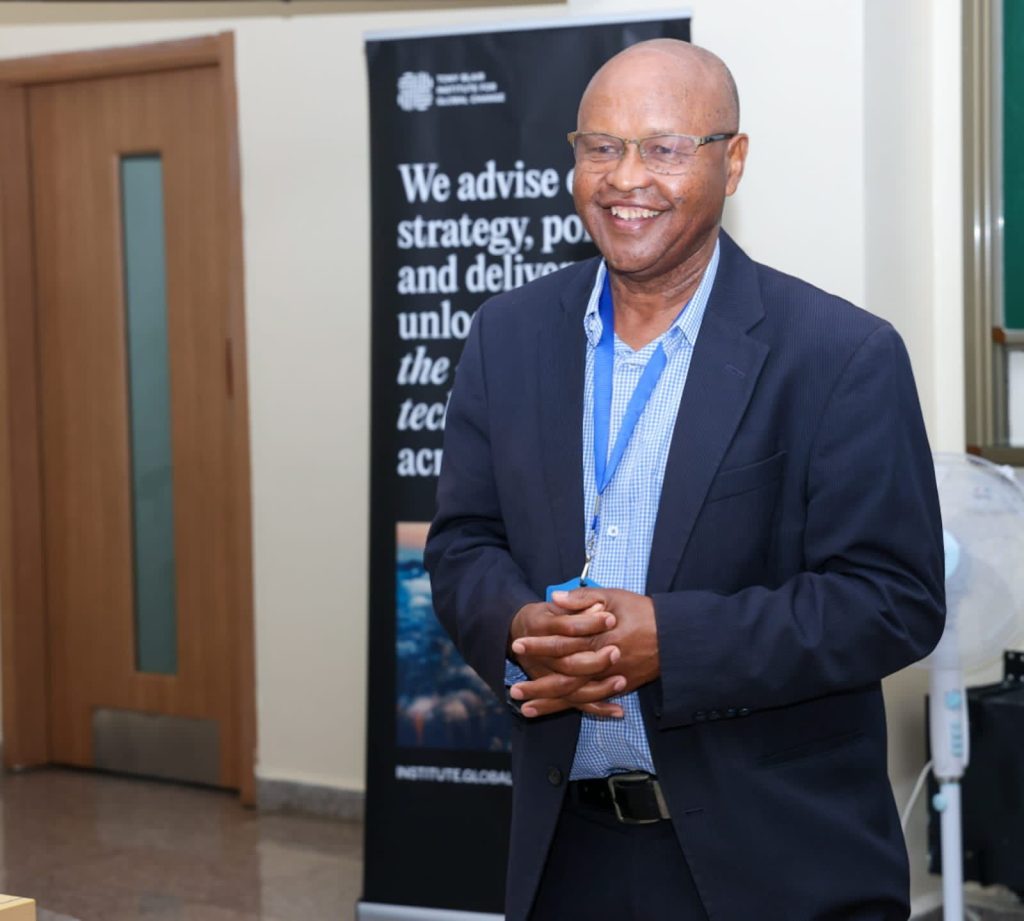
The Centre for Internet Governance and Policy Research (CIGAP) at @iLabAfrica Research and Innovation Centre, Strathmore University, proudly celebrates a significant academic milestone as Mr. John Sergon successfully defended his Doctor of Philosophy (PhD) thesis titled, “The Influence of Socio-cultural Orientation on Cybercrime: A Study of Mobile Money Cybercrime Landscape in Nairobi, Kenya,” in June 2026.
Successfully passing a PhD viva marks the culmination of years of rigorous research, resilience, and intellectual growth. For Sergon, whose distinguished career spans more than three decades in Kenya’s public service, including sitting at the helm of the ICT Authority before retiring in 2018, the achievement represents not just academic success, but a renewed commitment to shaping the future of cybersecurity policy through research.
“The journey taught me just how much there is still to learn,” Sergon reflects. “After working for over 30 years, I discovered that pursuing a PhD is an enriching experience that changes how you think, question, and solve problems. It gives you the confidence that almost anything is achievable.”
“The journey taught me just how much there is still to learn,” Sergon reflects. “After working for over 30 years, I discovered that pursuing a PhD is an enriching experience that changes how you think, question, and solve problems. It gives you the confidence that almost anything is achievable.”
Addressing One of Kenya’s Fastest Growing Cybersecurity Challenges
Kenya is globally recognised as a pioneer in mobile money innovation. Yet as mobile money adoption continues to transform commerce, financial inclusion and everyday transactions, cybercriminals have become increasingly sophisticated in exploiting both technology and human behaviour.
Motivated by this growing challenge, Sergon’s research explored an often-overlooked aspect of cybercrime, the influence of socio-cultural orientation on individuals’ vulnerability to mobile money cybercrime.
Rather than focusing solely on technological weaknesses, the study examined how people’s behaviours, attitudes, trust patterns and social interactions contribute to cybercrime risks.
“Mobile money has transformed our economy and our daily lives,” Sergon explains. “But unless we understand and address the cybercrime surrounding it, we cannot fully realise its transformative potential.”
Looking Beyond Technology
One of the study’s most significant findings was that cybercrime prevalence index (CPI) – a composite measure of the extent and frequency of cybercrime measure – across Nairobi County averaged 0.64, signifying a high prevalence of cybercrime among mobile money subscribers. Sub-counties of Kibra (0.78), Lang’ata (0.74), and Njiru (0.70) recorded the highest prevalence levels, reflecting a combination of socio-economic vulnerability, digital trust behavior, and weak reporting mechanisms. The research further revealed that although overall socio-cultural factors exerted minimal influence on the prevalence of cybercrime, the inclusion of demographic main effects improved the model’s explanatory power, demonstrating that the effect of socio-cultural orientation on cybercrime prevalence is partly conditioned by demographic factors.
The research documents the evolution of cyber threats affecting Kenyan mobile money users—from social engineering scams and fraudulent text messages to sophisticated SIM swap attacks and physical brute force
These findings reinforce the need for cybersecurity interventions that combine technology, policy and public awareness.
Research That Informs Policy
Beyond identifying challenges, Sergon’s doctoral research proposes a practical policy framework aimed at reducing mobile money cybercrime.
The framework emphasises:
- Increased public awareness and cybersecurity education.
- Behavioural approaches to reducing cybercrime vulnerability.
- Practical guidance for individuals, community groups and regulators.
- Evidence-based policy recommendations that strengthen Kenya’s cybersecurity ecosystem.
His long-term vision is to continue conducting research that directly informs national cybersecurity policy and strengthens digital trust in Kenya’s rapidly evolving digital economy.
“Research should not end on library shelves,” he says. “It should generate knowledge that informs policy and helps solve real societal problems.”
Like many doctoral candidates, Sergon’s journey was marked by numerous challenges.
He navigated changes in supervision, disruptions brought about by the COVID-19 pandemic, personal health setbacks and the demanding process of conducting research on a highly sensitive topic.
Despite these obstacles, he credits his supervisors, Professor Ankit Katrodia and Dr. Everlyne Makhanu, for their unwavering guidance throughout the journey.
“Supervisors play a critical role in the success of a PhD. Their support, encouragement and expertise were invaluable throughout this journey.”
Inspiring the Next Generation of Researchers
Now serving within @iLabAfrica, Sergon hopes his achievement inspires younger researchers and professionals to pursue doctoral studies earlier in their careers.
Surrounded daily by young innovators, researchers and students, he found renewed motivation to complete the journey, not just for himself, but to demonstrate what perseverance can achieve.
“If this journey does not inspire someone else to begin theirs, then I will have failed,” he says. “The earlier you start, the better. It is a beautiful journey that expands your thinking and opens doors you never imagined.”
As he embarks on the next chapter of his academic career, Sergon intends to continue advancing research that bridges cybersecurity, governance and public policy, ensuring that research outcomes contribute meaningfully to safer digital ecosystems both in Kenya and beyond.
His successful PhD defence reflects the growing research excellence within @iLabAfrica Research and Innovation Centre in general and CIGAP in particular, where interdisciplinary research continues to address complex societal challenges through technology, policy and innovation.
About CiGAP
The Centre for Internet Governance and Policy Research (CIGAP) , housed within @iLabAfrica Research and Innovation Centre at Strathmore University, advances research focusing on evolving governance and policy issues that impact the growth of the Internet, data governance, cybersecurity and related immerging technologies. Through interdisciplinary research and stakeholder engagement, CIGAP contributes to evidence-based policy that supports Kenya’s and Africa’s digital transformation.