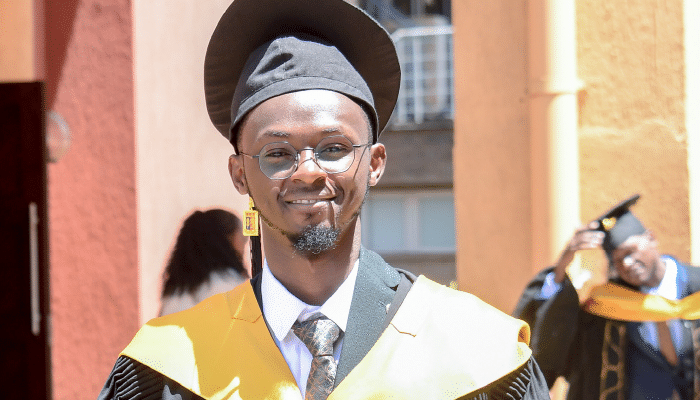
For software engineer Bonface Musila, a Master’s degree in Information Systems Security did more than add another qualification. It changed the way he sees every system he helps to build.
There was a time when Bonface Musila’s main concern about a piece of software was straightforward: Does it work?
Today, that is only the beginning. When he looks at a system, he also thinks about what could go wrong, where vulnerabilities might exist and whether the information within it is adequately protected.
“I’m no longer just a software engineer,” he says. “I’m a security software engineer.”
That shift in perspective is one of the biggest outcomes of his journey through a Master of Science in Information Systems Security at @iLabAfrica- Strathmore University.
A Curiosity That Started With Computers
Bonface’s fascination with technology began long before cybersecurity became part of his career. Growing up, he enjoyed experimenting with computers and discovering what they could do. At Kibabii University, where he studied Computer Science, that curiosity developed into practical skills.
In his first year, he began developing software using Python. By his third year, he had created a voice-enabled radio application that brought together different radio stations and allowed users to switch between them using voice commands. A year later, he developed an AI-powered news application capable of gathering stories from major media outlets and reading them aloud.
Both solutions were designed with accessibility in mind, particularly for people with disabilities. Even then, Bonface was thinking beyond the technology itself. He was interested in how it could make everyday experiences easier and solve real problems.
A New Perspective on Technology
After completing his undergraduate degree in 2021, Bonface gained practical cybersecurity experience at the Tai Security Operations Centre @ iLabAfrica- Strathmore University. In November 2022, he began his Master’s degree in Information Systems Security.
The journey was demanding, particularly during his dissertation. Regular meetings with his supervisor, Dr Joseph Sevilla, provided guidance and helped him remain focused throughout the research process. The programme also connected him with fellow students and professionals who have remained part of his network beyond the classroom.
But its greatest impact has been on his work. As a software engineer, Bonface had always focused on building systems that performed their intended functions. The Master’s programme added another dimension to that thinking: how secure are those systems?
A system can work perfectly and still be vulnerable. That realisation now influences how he approaches software development, particularly when working with systems that handle sensitive information.
Building Technology People Can Trust
Bonface has contributed to the Public Procurement Information Portal, a platform that makes government procurement information available to the public and supports greater transparency. He has also worked on health technology projects involving data visualisation and health information management, an area in which he is currently involved.
His Master’s degree has also strengthened his research skills, enabling him to approach complex challenges more systematically. He is currently applying this knowledge to work focused on security in procurement systems.
For Bonface, the real value of further education has been more than academic. It has changed the way he approaches his profession. The curiosity that once led him to experiment with computers has evolved into a career focused on building technology that is not only functional, but also secure and reliable.
And perhaps that is the most lasting lesson from his journey.
“Education does not always change what you do. Sometimes, it changes the way you do it.”
Bonface Musila recently graduated with a Master of Science in Information Systems Security from @iLabAfrica-Strathmore University, taking with him a new perspective on software development, cybersecurity and the responsibility that comes with building technology people can trust.