Transparency International Kenya (TI-Kenya) is a national civil society organization that works towards a transparent and corruption-free society.
Registered in Kenya in 1999 with a mission to combat corruption, we are dedicated to promoting integrity, transparency and accountability in the public and private spheres through good governance and social justice initiatives.
With over 25 years’ experience in governance interventions at the national and county levels, we work collaboratively with partners, institutions and citizens to prevent, expose and challenge corruption, and to strengthen systems that uphold good governance and public integrity. We pursue advocacy, partnerships development, strategic litigation, research, capacity building, and civic engagement as our core approaches.
As an independent chapter within the global Transparency International movement, we operate within our own governance structures and resources, strategies, and programmes tailored to Kenya’s unique governance landscape.
Our main office is in Nairobi, with regional presence in the Coast, Rift Valley, Western, and Eastern Kenya through four Advocacy and Legal Advice Centres (ALACs) in Mombasa, Eldoret, Kisumu, and Nairobi.
TI-Kenya in partnership with the Electoral Law and Governance Institute for Africa (ELGIA), URAI Trust and Centre for Multiparty Democracy (CMD), and with support from the Foreign, Commonwealth and Development Office (FCDO), is implementing the Kenya Institutional Strengthening Program (KISP). This partnership provides a strategy for delivering programming support through KISP to Strengthen Kenya’s Anti-corruption framework, Promote Public Debt Accountability and Transparency, enhance the integrity of key electoral processes ahead of Kenya’s 2027 Elections, and counter the use of illicit money in Political activities in Kenya in the long-term. KISP aims to provide an integrated framework as a strategy for achieving transformative agenda envisioned in the Kenya’s 2010 Constitution that emphasizes strong legal framework, public accountability, and strong institutions.
Political financing is defined as the legal and illegal financing of ongoing party activities and electoral campaigns.[1] Funding of political activities in any democracy is considered as essential to sustain a healthy political culture where political parties can carry out their activities throughout and during election periods. These results in strong political parties and enhanced political awareness and civic duty from citizens building a culture of issue-based politics as opposed to ethnic, individual and constricted political discourse.
However, secret political finance risks corruption if political financing does not take place in a fair manner resulting in the lack of a level playing field among political parties, unfair representation and overall distrust in political parties and political processes more generally.[2] Lack of transparency and accountability in political financing results in opacity on who is influencing decision makers or candidates for political office. According to International IDEA, “inadequately controlled political finance is one of the most widely exploited entry points for narrow private interests to exert undue influence over politics and political decisions.”[3]
In 2017, the Organization for Economic Co-operation and Development (OECD) adopted a new legal instrument called the Recommendation on Public Integrity, which calls on countries to deal with political finance, managing conflicts of interest, lobbying transparency, asset disclosure of public officials and other aspects of anti-corruption issues in a holistic manner throughout the political cycle.[4] Similarly, the Open Government Partnership (OGP), which Kenya is a member[5], advocates adopting commitments to advance political finance transparency as part of broader national open government action plans.
[1] https://knowledgehub.transparency.org/guide/topic-guide-on-political-finance/5186
[2] https://knowledgehub.transparency.org/guide/topic-guide-on-political-finance/5186#1
[3] https://www.opengovpartnership.org/policy-area/political-finance/
[4] https://www.idea.int/sites/default/files/publications/political-finance-reforms.pdf
[5] https://www.opengovpartnership.org/members/kenya/
The Political Parties Act (PPA), 2011 establishes the Political Parties Fund administered by the Registrar of Political Parties. The Fund is distributed to eligible political parties based on legal criteria. The main source of the Political Parties Fund is the National Government (0.3 % of National Revenue) with other recognized sources that may include: membership subscription fee, contributions and donations.
The Constitution of Kenya under Article 88 (4) (i), provides for the mandate of IEBC to include, among others, “the regulation of the amount of money that may be spent by or on behalf of a candidate or party in respect of any election”. The Electoral Campaign Finance Act, 2013[1] seeks to implement Article 88(4)(i) by making provisions for the regulation, management, expenditure and accountability of election campaign funds during election and referendum campaigns.
The implementation of the Elections Campaign Financing Act has faced hurdles since its enactment in 2013. Attempts to by-pass the various hurdles which have impeded the realization of the ECF Act have even gone to court with two Petitions No. E540 of 2021 Katiba Institute & Another vs. Independent Electoral and Boundaries Commission & Others and Petition No. E546 of 2021 Transparency International-Kenya vs. The Speaker National Assembly & Others.[2] The court in these petitions called upon the Independent Electoral and Boundaries Commission to “…proactively and timeously come up with the regulations contemplated under Article 88(4)(i) of the Constitution so that this country has in place the requisite regulations and the necessary spending limits. In doing so, the Commission will be inter alia promoting constitutionalism…”
With the lack of implementation and enforcement of campaign financing laws in Kenya, the adoption of a series of measures to regulate political financing remain crucial to curb corruption and ensure a level playing field.
[1] https://new.kenyalaw.org/akn/ke/act/2013/42/eng@2022-12-31
[2] https://africog.org/wp-content/uploads/2024/05/Constitutional_Petitions_E540__E546_of_2021_Consolidated.pdf
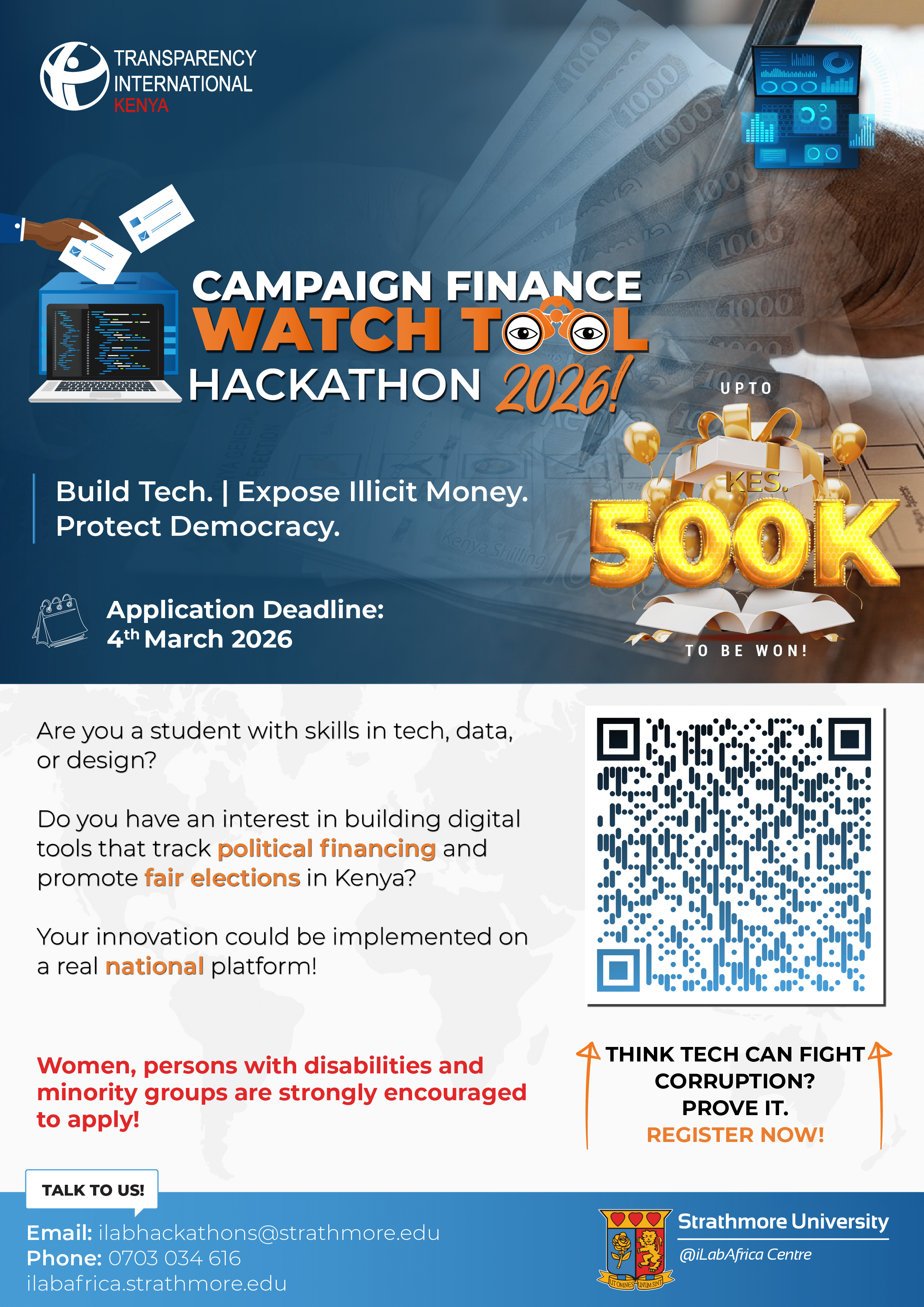
The Campaign Finance Watch Tool Hackathon challenges young techies to develop a digital platform that:
✔ Tracks political financing
✔ Visualizes data for public understanding
✔ Monitors misuse of public resources in campaigns
Your innovation could shape how Kenyans hold leaders accountable.
Choose one challenge:
- Challenge 1: Design and develop an innovative platform for the Campaign Finance Wach Tool
- Challenge 2: Create enhanced data visualizations using real political finance data.
- ✔ Teams of up to 4 members (at least 1/3 gender representation)
✔ Students in ICT, Computer Science, Design, Journalism, Media, Statistics or related fields
✔ At least one team member with 2+ years development experience
✔ Skills in: Web development, UI/UX, data visualization, graphics, CMS, HTML, CSS, JS
✨ Training & mentorship
✨ Chance to implement your solution on a national platform
✨ Grants for winning teams
✨ Visibility & real-world impact
✨ Network with governance & tech leaders
1️⃣ Apply online visit @iLabAfrica
2️⃣ Successful teams proceed to Hackathon Conference
3️⃣ Build & submit a prototype + pitch
4️⃣ Present to a judging panel
The submitted final pitch will be evaluated against a technical criterion with a maximum score of 100. The technical evaluation will include the following:
Criteria | Points |
Relevance – The proposed solution demonstrates that it understands and addresses the CHALLENGE with use of compatible tools with existing platform. | 30 |
Quality – The final solution prototype has been tested and works. For technical solutions, the prototype has been tested for technical bugs and performance issues. | 20 |
Viability – The solution can be implemented and is scalable. | 30 |
Novelty – The solution is original and uses new and improved tools with enhanced capabilities to improve functionalities. | 20 |
TI-Kenya is committed to achieving workforce diversity in terms of gender, age and culture. Individuals from minority groups, indigenous groups and person with disabilities are encouraged to apply. All applications will be treated with the strictest of confidence.
Winners:
KES. 500,000
1st Runners Up:
KES. 300,000
2nd Runners Up:
KES. 100,000
APPLICATION FORM
Applications are closed.